
Breaking Boundaries: From the Cell’s Edge to the Heart of Gene Expression
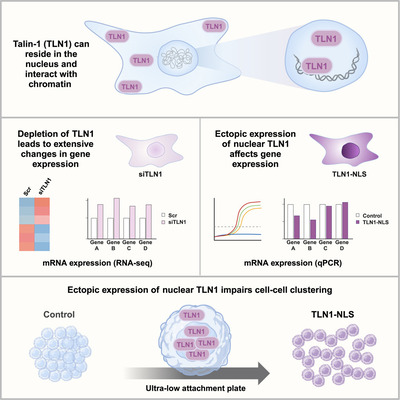
Proteins are typically located in particular compartments within the cell, where they perform specific functions. However, proteins can also be found in unexpected cellular locations, suggesting that they might play novel roles yet to be discovered.
A team of researchers at Åbo Akademi University, led by Professor Lea Sistonen (Professor of Cell and Molecular Biology) and Docent Eva Henriksson (University Lecturer in Cell Biology), made a surprising discovery. They found that Talin-1, a protein primarily known for its role in cell adhesion at the periphery of the cell, can also be located in the cell nucleus, where the genetic material resides. Remarkably, nuclear Talin-1 was shown to influence the expression of genes that regulate cell-to-cell connections.
“Our results were surprising and required extensive verification, as Talin-1 has been studied for decades outside the nucleus, thereby challenging the established view of how Talin-1 functions”, explains Dr. Alejandro Da Silva, who is the first author of the recently published article entitled “Nuclear talin-1 provides a bridge between cell adhesion and gene expression”.
In the periphery of the cell, Talin-1 senses mechanical forces, stabilizes the adhesion of cells to their surroundings and facilitates cell movements in the body. Therefore, the surprising finding of nuclear Talin-1 raises numerous questions for future investigations. For example, how Talin-1 travels to the nucleus and whether sensing mechanical forces is required for its capacity to control gene expression. This discovery in basic Cell Biology has important medical implications, because mutations in Talin-1 have been linked to several diseases, such as cancer, cardiomyopathies, and hematologic disorders. Consequently, Talin-1 has already been suggested as an attractive drug target. Advancing our understanding of Talin-1’s cellular localization and function is therefore a critical step towards exploring its therapeutic potential.
This research was conducted within the CellMech Center of Excellence in Mechanostasis (2019–2023) at Åbo Akademi University. The CellMech project aimed to investigate how mechanical signals affect the functioning of cells and tissues. The study was financially supported by the Finnish Cultural Foundation and the Ella ja Georg Ehrnrooth Foundation. The results were published in iScience, an open access journal which belongs to Cell Press and can be found here.
For further information please contact:
Lea Sistonen, Professor of Cell and Molecular Biology
E-mail: lea.sistonen@abo.fi
Telephone: 02-2153311, 050-4013513
Eva Henriksson
E-mail: eva.henriksson@abo.fi
Alejandro Da Silva
E-mail: adasilva@abo.fi
Recent Posts
- Researchers are investigating how snakes lost their limbsSnakes have not always been legless, but have lost their limbs through evolution. Professor Laura Read moreOctober 8, 2026
- Frontiers of Science seminars are starting this weekAutumn 2026 Frontiers of Science seminars start this week. Come for a coffee and sandwich Read moreOctober 5, 2026
- Dissertation Defence: Eleftheria MaranouMSc Eleftheria Maranou, from affiliated MIORG group, succesfully defended the dissertation in Immunology titled “The Achilles’ heel of Read moreSeptember 1, 2026
- Researchers discover molecular mechanism that helps aggressive colorectal cancer to spreadResearchers from the University of Turku in Finland, Turku Bioscience Centre and Gustave Roussy Institute Read moreAugust 25, 2026
- The Novo Nordisk Foundation has awarded funding of approximately one million euros to a research project led by Professor Jukka WestermarckThe Novo Nordisk Foundation has awarded funding of approximately one million euros to a research Read moreAugust 21, 2026
- The Jane and Aatos Erkko Foundation has granted nearly €1 million to support research led by Professor Jukka Westermarck993 000 € was granted to a research project led by our Group Leader Professor Jukka Read moreApril 2, 2026