
Researchers discovered promising approach to prevent recurrence of breast cancer
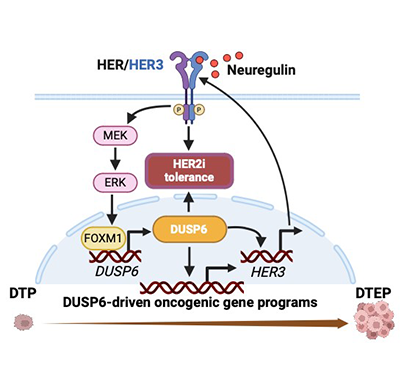
Treatment outcomes for breast cancer have become better over the years, but proportion of breast cancers still recur even after long periods without signs of cancer remaining dormant in the body. Finnish cancer researchers discovered a mechanism that wakes up these dormant breast cancer cells and demonstrated that preventing the mechanism can significantly improve treatment outcomes in experimental models.
Although treatment outcomes for breast cancer have significantly improved through new research-based therapies, it remains the second most common fatal cancer in women. A particular challenge in breast cancer treatment is the recurrence of the disease. Even when treatment appears to be successful and the cancer is considered gone, it can return years later either locally or, in the worst case, by spreading to other parts of the body, such as the brain.
The reasons why dormant breast cancer cells awake even after several years are not well understood. However, identifying these reasons could provide an opportunity to develop new therapies to prevent cancer recurrence.
DUSP6 protein activity associated with awakening of the breast cancer cells
A newly-published Finnish study provides important new insights into how breast cancer cells belonging to the HER2-positive subtype are able to awaken during treatment.
The research group led by Jukka Westermarck, the Professor of Cancer Biology at the Turku Bioscience Centre and the InFLAMES research flagship of the University of Turku and Åbo Akademi University, approached this research question by treating breast cancer cells sensitive to treatment with HER2 inhibitor for nine months and by monitoring how these cancer cells were able to restart their growth during the treatment.
By sequencing the molecular changes in the cells, the group identified the DUSP6 protein, whose expression closely followed the development of therapy resistance. The leading researcher Majid Momeny was also able to show that when the activity of the DUSP6 protein was blocked during cancer treatment, breast cancer cells lost their ability to grow. Blocking the protein also made the previously treatment-resistant cancer cells more sensitive to HER2 inhibitors. Another important finding was that by inhibiting DUSP6, it was possible to slow the growth of breast cancer metastases in the brain in mouse models.
“Based on our findings, blocking the DUSP6 protein could therefore provide a basis for effective combination therapy also in HER2 breast cancer cases that have already lost response to treatment,” says Professor Westermarck.
The significance of the study is highlighted by the group’s access to experimental drug molecules that inhibit the DUSP6 protein. By administering the drug, the researchers demonstrated that the protein could be inhibited in mice without significant side effects. Importantly, the drug was shown to significantly enhance the therapeutic effect of several existing HER2 inhibitors.
“The molecules we used in this study are not yet suitable for patient treatment, but these newly-published basic research results provide important evidence that DUSP6 is a very promising target protein for future cancer drug development and worth investigating,” Westermarck continues.
The research article “DUSP6 inhibition overcomes Neuregulin/HER3-driven therapy resistance in HER2+ breast cancer” was published in prestigious translational medicine journal, EMBO Molecular Medicine. The research group was funded by several Finnish foundations, mainly the Cancer Foundation Finland, Foundation for the Finnish Cancer Institute, and the Finnish Cultural Foundation.
Recent Posts
- Turku Protein Core Opens Two New PositionsTurku Protein Core (TuProtCore) is seeking to fill two roles: a Project Specialist in Service Read moreApril 7, 2026
- The Jane and Aatos Erkko Foundation has granted nearly €1 million to support research led by Professor Jukka Westermarck993 000 € was granted to a research project led by our Group Leader Professor Jukka Read moreApril 2, 2026
- Cecilia Sahlgren’s group discovers a new mechanism driving breast cancer progressionOur affiliated research group led by Professor Cecilia Sahlgren at Åbo Akademi University and the InFLAMES Research Read moreMarch 25, 2026
- BioCity Turku asks for proposals for Elias Tillandz publication prize winner during March 2026In the context of the 35th BioCity Symposium “Vision, Expanded” (27-28 August 2026) the twenty-second Read moreMarch 3, 2026
- Rector Widen Visited Our Centre Åbo Akademi University Rector, Gunilla Widén, visited our Centre on Wednesday, February 25th, to learn Read moreFebruary 27, 2026
- Laura Elo is awarded the Leif C. Groop Award for outstanding research on type 1 diabetesLaura Elo a group leader at Turku Bioscience is awarded the Leif C. Groop Award Read moreFebruary 23, 2026